
Start every stage with the money already there.
Your client pays for each stage before you start, and you can see the money is there.
- Released when your client approves. It can take up to a day to reach your bank.
- £60 + VAT (£72) on a £6,000 stage, taken from the payout.
- No subscription, no setup fee.
Builders who join by 31 January 2027 pay no builder fee on their first three projects. Offer terms
- Held securely until your client approves the work
Foundations and groundworks
£6,000
- Your client pays the stage
- Held securely
- You finish and request approval
- Your client approves
- Released. Can take up to a day to reach your bank
Nothing has moved yet. Your client pays first.
See it in the app
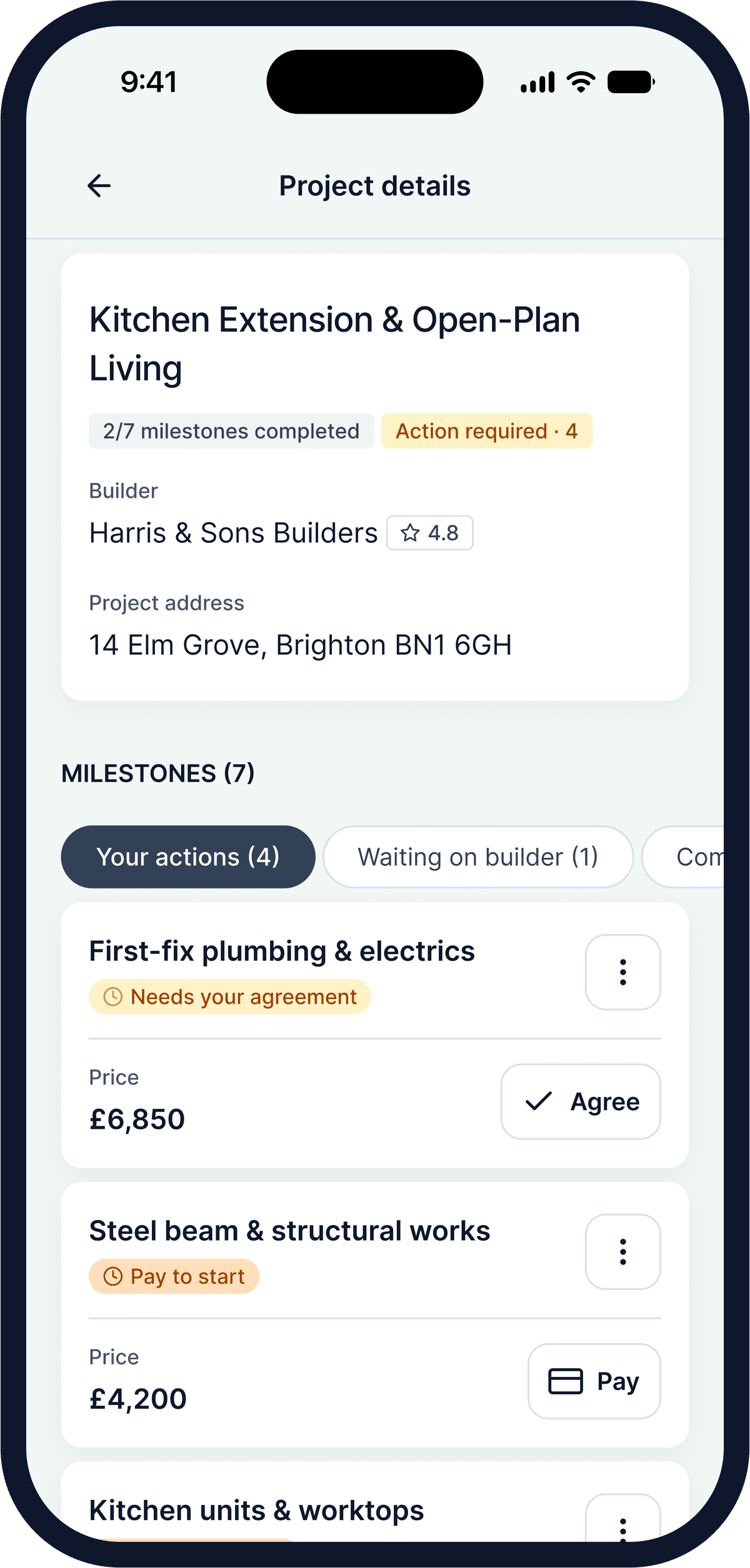
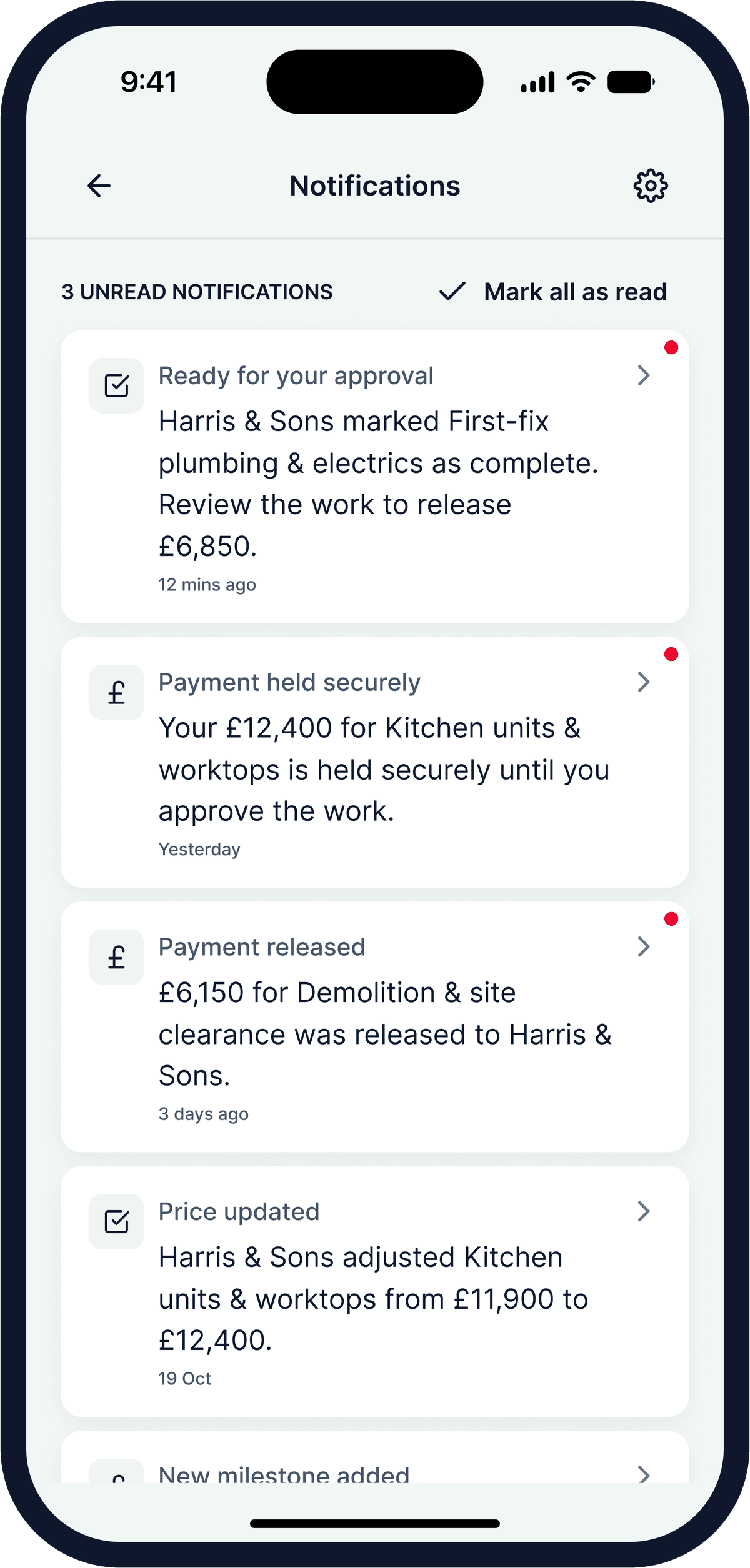
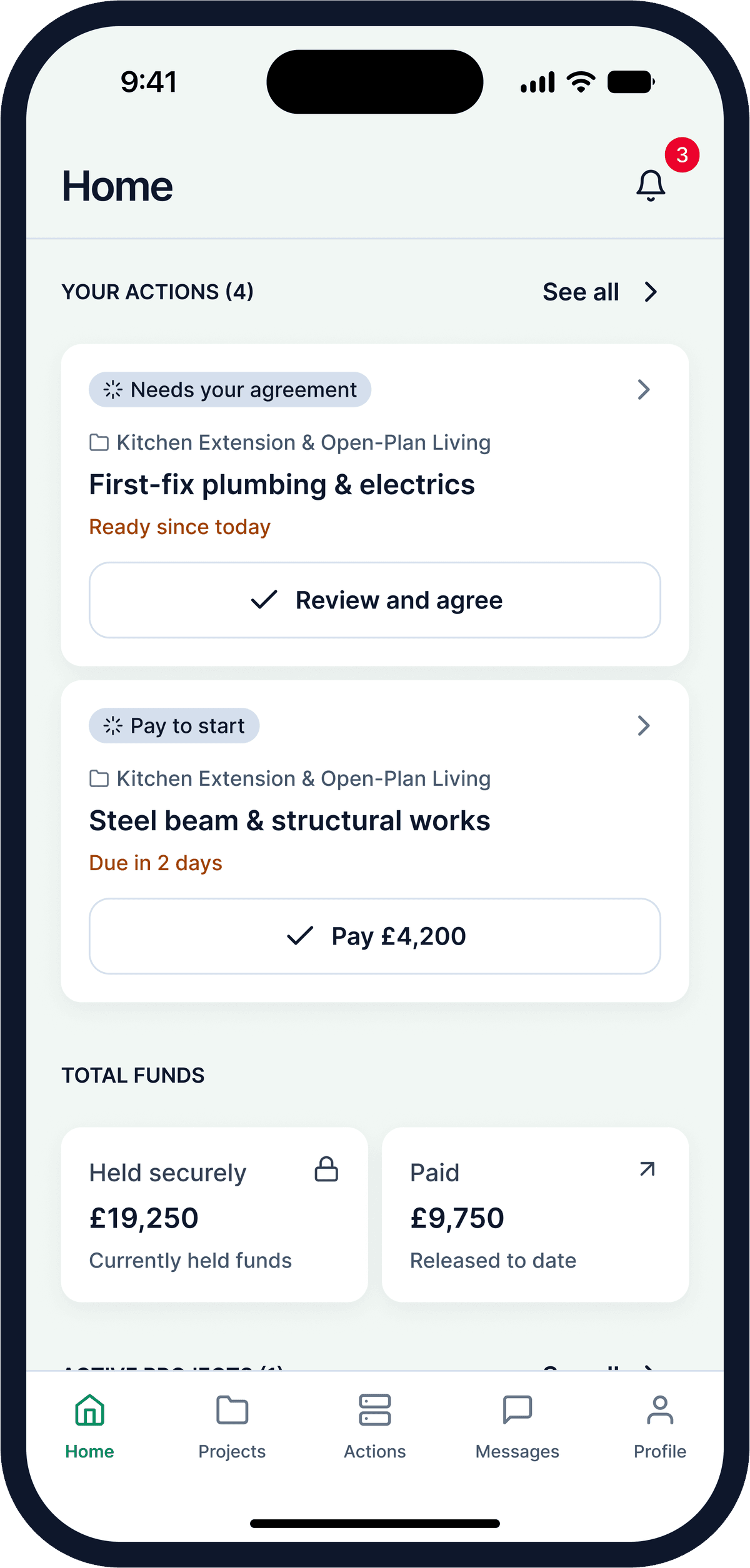
Screens from the Renopay app. Example project shown.
What to tell your client
Copy it into a quote or a message.
I use Renopay for payments. You pay for each stage before it starts, and it is held securely. The money is released to me when you approve that stage. You never hand me a big deposit, and I never start work without knowing the money is there.
An example stage plan
Single storey rear extension, £60,000, in the seven stages from our house extension guide. On a kitchen or bathroom, ordering it is a stage of its own, so the money is held before you place the order.
| Stage | Done means | Share | Amount | Builder fee |
|---|---|---|---|---|
| Site set-up | Scaffold, fencing and skips in, services found, and the extension set out on the ground. | 5% | £3,000 | £30 + VAT (£36) |
| Groundworks, foundations and drainage | Foundations dug, inspected and poured, drainage laid, ready for the floor. | 18% | £10,800 | £108 + VAT (£129.60) |
| Walls, floor slab and structural opening | Walls up, slab poured, and the opening into the house formed on a steel beam. | 20% | £12,000 | £120 + VAT (£144) |
| Roof, glazing and weathertight shell | Roof on, windows and doors in, and the inside stays dry in rain. | 17% | £10,200 | £102 + VAT (£122.40) |
| First fix, insulation and plastering | Cables, pipes and insulation in, screed down, and the walls plastered. | 15% | £9,000 | £90 + VAT (£108) |
| Second fix, fit-out and decoration | Sockets, radiators, doors and floors fitted, the kitchen or bathroom in, and decorated. | 20% | £12,000 | £120 + VAT (£144) |
| Outside, snagging and handover | Garden made good, scaffold down, snag list closed and certificates handed over. | 5% | £3,000 | £30 + VAT (£36) |
The planner turns your quote into stages like these, then starts the project with them in it.
Versus asking for a deposit
Ask for £6,000 up front
The client hesitates. You either lose the job to someone who asks for less, or you start exposed and chase the rest at the end.
The client pays £6,000 into a held stage
They are comfortable because they have not handed it to you yet. You are comfortable because you can see it.
Late payment is still normal in the trades
68%
of people working in the trades were chasing at least one late payment
Direct Line business insurance survey, reported by Credit Connect, 20 January 2026 (opens in a new tab)
£2,023
average amount owed to a trades business in late payments
Direct Line business insurance survey, reported by Credit Connect, 20 January 2026 (opens in a new tab)
£11bn
what late payment costs the UK economy each year, closing 38 businesses a day
Department for Business and Trade, press release (opens in a new tab), 30 July 2025
Sign up free
You need photo ID and a bank account. A sole trader signs up with the ID check alone. It takes about ten minutes and happens once.